

It's difficult to pinpoint the moment when a game against Dorinthea Ironsong slips away from me. The outward signs vary widely - full grips, Ironsong Determinations, Twinning Blades, Singing Steelblades - but even as those notes punctuate the dire situation I've found myself in, there's a bass line that runs further back, driving home a hard truth: we were already here.

I've been tracking every one of my games for the past 16 months, and in that time my record vs. Dorinthea is 3-10. But those statistics are deceptive, as they include wins in Blitz and Commoner. In Silver Age, I've lost 2 games against Dorinthea; and in Classic Constructed, I'm 0-5. This past Road to Nationals season, I bubbled out of Top 8 due to a draw and a streamed loss to Dorinthea (piloted by MaxFerocity, no less).
Dorinthea has a reputation as a skill check for the early days of a FAB player's career. Her emphasis on reactions feels like cheating compared to the 'honest' Flesh and Blood gameplay of most decks. And the penalty for getting it wrong is growing value on a recurring sword that hits you turn after turn. It's not unusual to hear someone online complaining about Dorinthea, and usually the answer is, "learn a new framework".
And I swear to you, I have already gone through that entire process back in 2021.
Dorinthea was my first deck, and for a long time I considered her one of my mains (alongside Azalea and, eventually, Dash 1.0). I taught many of my local players how to overcome her. I had locals who have developed skills on her, and I've been able to best them many times in the past. I know about over-blocking by 3; I know about the ebb and flow of heavy blocking one turn and no-blocking the next; I can read a reprise in arsenal and a Glint in hand.
But somewhere in the last three years, Dorinthea leveled up. And maybe I'm only now realizing it, or maybe something in Compendium of Rathe pushed her over the edge, or maybe I've slipped. But maybe, just maybe, Dorinthea is actually great right now.
Solana's Golden Girl
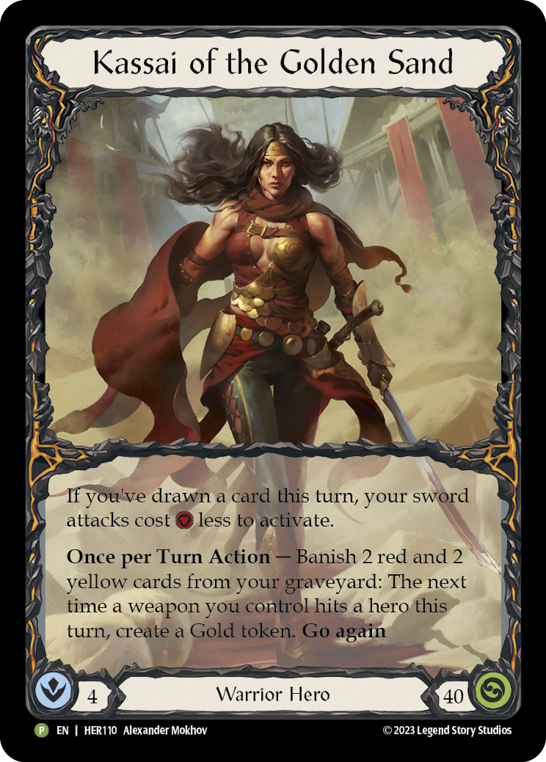
While Warriors have long had a reputation for being too 'fair', there have nonetheless been success stories. Kassai recently found her way to the A-Tier, where she was seen as a well-rounded pick that gave outsized prominence to skill expression. Disciplined players who could read their opponents could pivot for a variety of play patterns while maintaining a pathway to victory. (This same prerequisite of skill played a role in keeping Kassai's numbers down, as other decks offered less resistance for a player picking up the deck for its meta relevance.)
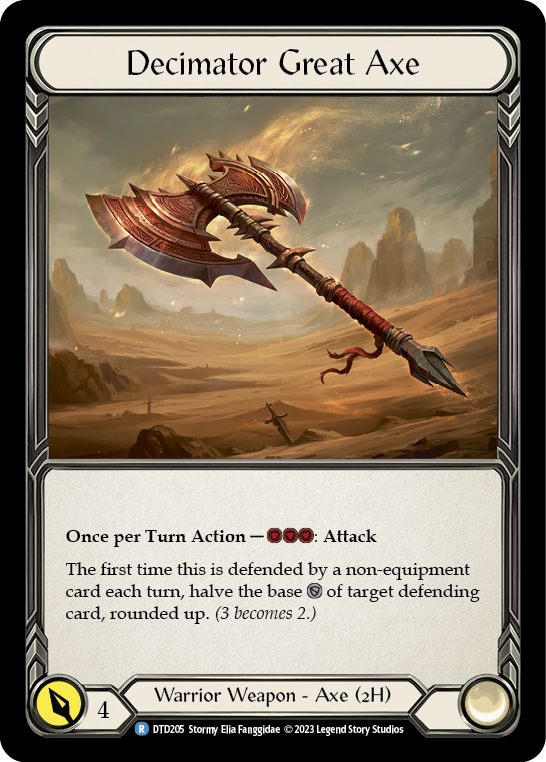
Then there's the perennial threat of Decimator Great Axe, a weapon so deck-defining that the hero who wields it is largely irrelevant. In fact, the chameleon cloak of an unexpected hero/Axe pairing has proven to be one of its greatest strengths; it's impossible to board correctly into a Fang who could either be Dagger Aggro or Axe Fatigue.
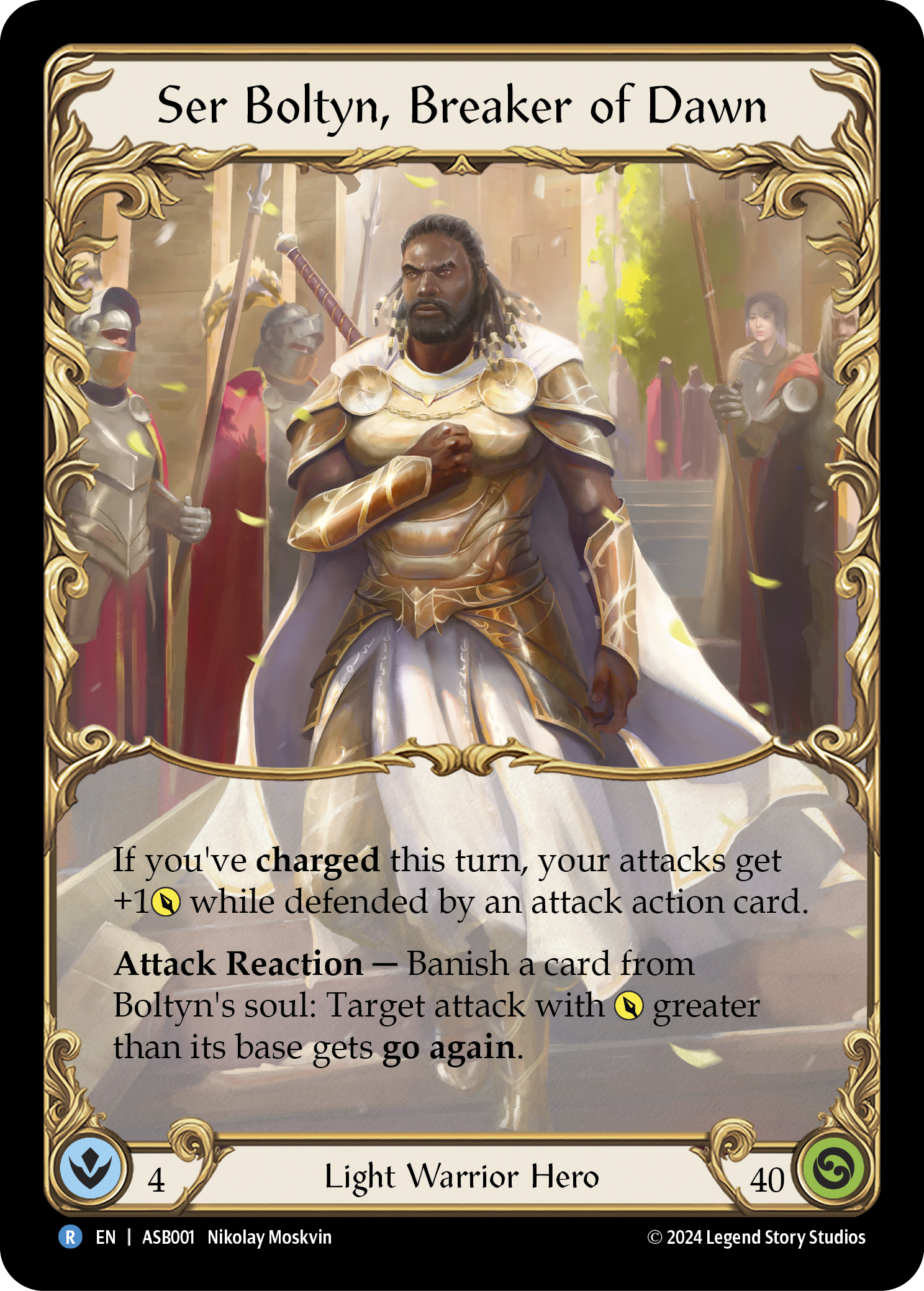
But while we seldom see Warriors at the top of the meta, specialists continue to raise the lethality in region-specific ways. It doesn't seem to matter what the wider statistics show - if you have a strong Warrior main in your area, you will invariably find them claiming top spots from Armories to Pro Quests. In Wisconsin, where I play, Alex Tyler is one such Warrior devotee. It was the Year of Our Lord 2024, and Alex Tyler was winning Pro Quests with Boltyn.
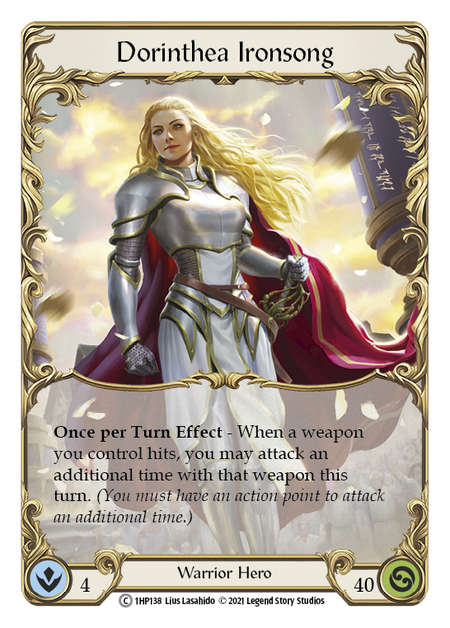
With that in mind, it's not unreasonable that Dorinthea may be rising in 2026. If Warriors are a consistency class, if dedication is rewarded, then the longer Dorinthea mains spend with her, the better their results should be. I theorize that, any time the meta gets shaken by a Living Legend departure (or several, as has been the case so far this year), the dormant potential of the Warrior class - masked by meta-defining powerhouses - should once again become clear.
Get Good, Alex
And yet it remains true that Warrior, for all that it plays within the reaction phase, is rigidly bound to the underlying numbers of the game's design. As we prepped for the release of The Hunted, I wrote a speculative piece on Fang that dug into the numbers on Warrior's card pool, and what I found is that it's remarkably hard for Warrior to break the boundaries of its math. I'll quote from there:
For each card in hand and each resource, we can assume the [Sword] Warrior's weapon attack can climb by 3. And if we know their goal is to attack twice in a turn, their ability to operate outside of that schema on any given attack is relatively limited. Unblocked, the potential of a single sword swing looks about like this:
- 2H Sword with 2 floating and 3 in hand: 3 base [+3 reaction +3 reaction] = 9 (and 1 card left in hand)
- 2H Sword, buffed by a non-attack action, with 2 floating and 2 in hand: 3 base +3 buff [+3 reaction +3 reaction] = 12
- 1H Sword with 2 floating and 3 in hand: 2 base [+3 reaction +3 reaction] = 8 (and 1 card left in hand)
- 1H Sword, buffed by a non-attack action, with 2 floating and 2 in hand: 2 base +3 buff [+3 reaction +3 reaction] = 11
Of course, this is an oversimplification of the Warrior strategy. But at its core this is what you're staring down when a Warrior lines up that first swing. If you're looking to just tank and race, this is what's on offer - and for all the variation available between heroes, the core math of the class remains this, almost without exception: 4 cards makes 12.
The important caveat here is that, if the Warrior has more than one weapon swing in a turn, those numbers can be divided into awkward chunks - which is basically the entire strategy of the much-more-faceup Kassai. That said, Kassai has to work much harder to make you care about blocking her fully; Dawnblade Dorinthea, whose on-hit is cumulative and builds momentum, relies more on that first attack landing to even offer a second swing.
In the end, the best way to approach the Dorinthea matchup really hasn't changed: block the first attack heavily, and they probably can't convert their hand. Stuff your deck in anticipation of a longer game, and play knowing that a fatigue state favors a weapon-based deck. Try not to get greedy, but if you do, fully commit to the biggest play you can make, then block out on the following turn to prevent the accumulation of multiple Dawnblade counters.
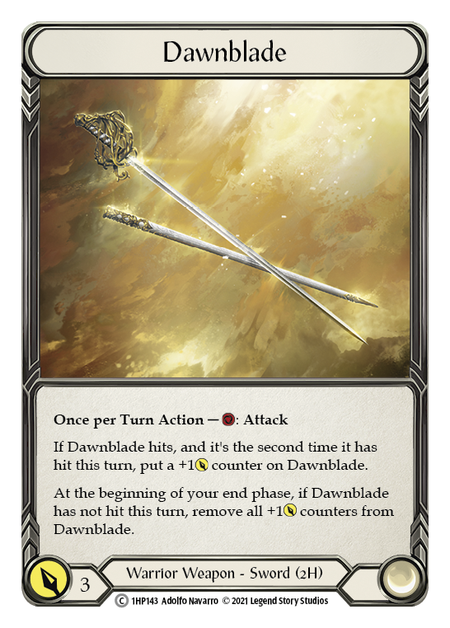
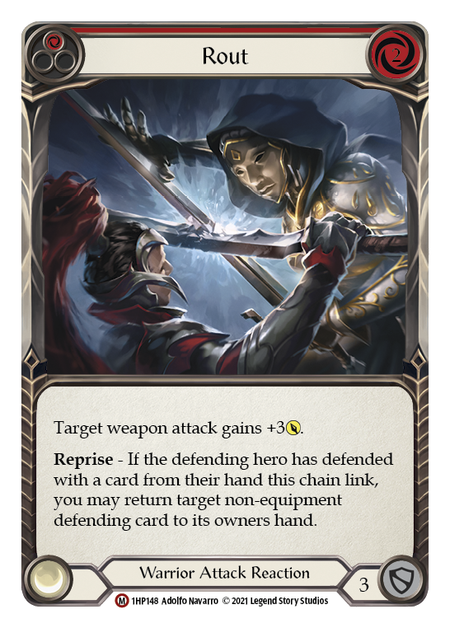
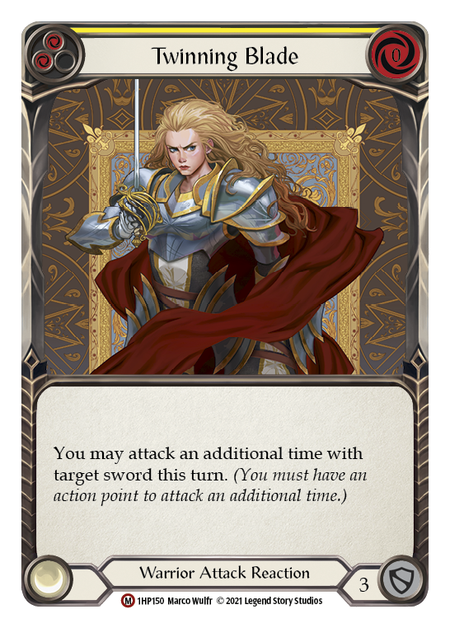
But even with all that said, know that you will get got. There will be times when Dorinthea has the Twinning Blade and gets to save her buffs for a second attack when you've already tall-blocked the first. Sometimes the Rout kills you.
And while it's easy to think of reaction-based decks as unfair, you can't really view those cards in hand as complete unknowns. If they have a resource floating, if they have a card in hand, if the attack looks soft... that's almost certainly a +3, and you can block it as though the card has already been played.
It's Not the Moment, It's the Mastery
For the first 4 months of 2026, I've been forced on a journey of realization and rivalry thanks to my local Dorinthea devotee. And while the matchup spread for Dorinthea looks pretty positive for her, when you switch the filter from online games to paper games, the skill gaps so common to online play start to look pretty undeniable. The hard truth is, that guy who's beating you on Dorinthea probably is that good.