
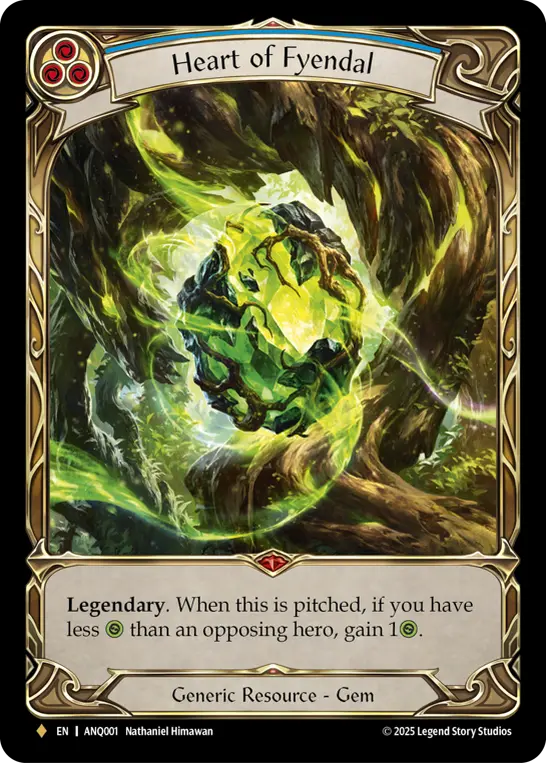
In the world of Flesh and Blood, there are collectibles rarer than a Cold Foil Heart of Fyendal, a Gold Foil Arcanite Skullcap, or even the Kassai Command and Conquer. Artist Proofs (APs) are among the rarest and most misunderstood items in the game.

As AP collecting has grown in Flesh and Blood, the term “Artist Proof” has increasingly been applied to items that may not fit the historical definition. Between inconsistent print runs, unusual distribution methods, promotional items, and alternate print treatments, the lines of what should and should not be considered an AP have become blurred.
This article examines the history of APs in Flesh and Blood, establishes a working definition for what an Artist Proof actually is, and evaluates several controversial items against that standard.
What Is an Artist Proof?
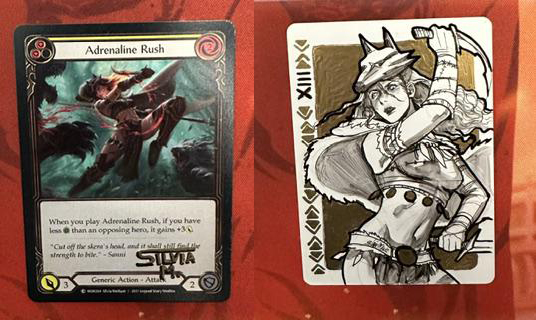
At first glance, an Artist Proof may look like a normal signed card. If someone bought one on the secondary market in a sleeve, it could easily be mistaken for any other signed copy. However, the defining feature of an AP becomes obvious once the card is turned over.
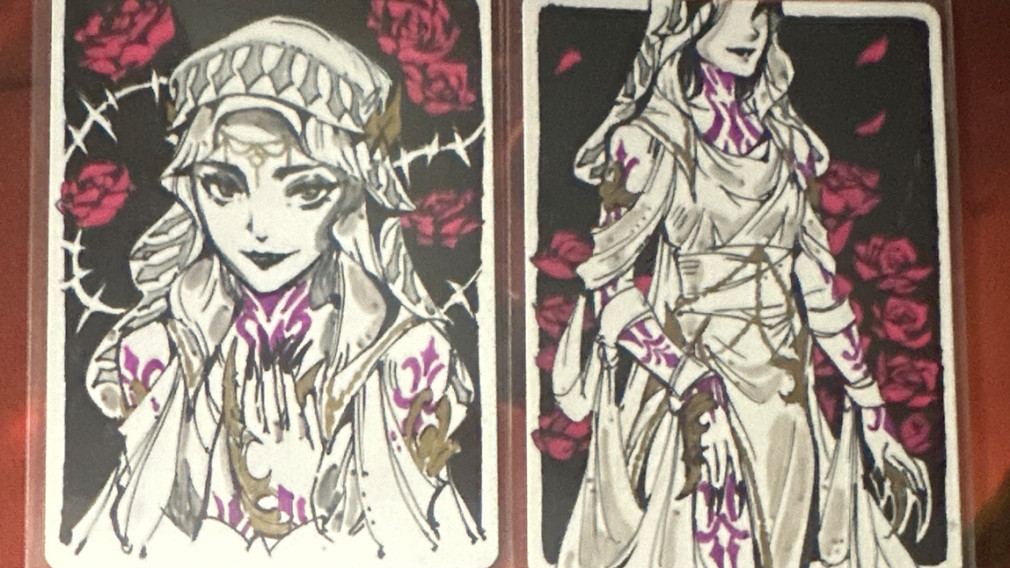
Artist Proofs are cards sent by the game company directly to the artist with completely unprinted white backs. Because of this, they are often referred to as “white-backs.” The blank reverse side allows artists to sketch, paint, or otherwise customize the card however they choose. Some collectors prefer untouched white-backs, while others seek out those that have artwork on the back ranging from quick doodles to detailed miniature masterpieces.
This concept has existed in trading card games for decades. The earliest APs are generally traced back to Magic: The Gathering’s Collector’s Edition in the 1990s. Since then, APs have become an established part of TCG collecting culture across multiple games.
A notable exception within Flesh and Blood itself are Dynasty APs, which were cut differently than other Flesh and Blood cards and feature significantly more rounded corners. Despite these manufacturing differences, they still fit the broader historical concept of an Artist Proof.
The History of APs in FAB
Not every Flesh and Blood card has Artist Proofs. Most recently, the Compendium of Rathe set did not have APs produced for the antique-framed cards found in Antiquity Packs. Multiple artists have confirmed this directly.
The history of AP distribution within Flesh and Blood has also been highly inconsistent. During the game’s earliest sets, some artists received healthy quantities of proofs while others received only a single copy or none at all. The situation worsened with Arcane Rising and Crucible of War, where almost no artists appear to have received APs through normal distribution channels.
There were, however, a few exceptions. Artists attending major events such as Callings or the San Jose World Championship were sometimes given AP packages directly by Legend Story Studio. Interestingly, some of these proofs appeared to come in packaging different from what later became standard, including plain white cardboard boxes that differed from modern AP shipments.
Global events also complicated AP distribution. Since the beginning of the Russia-Ukraine war, some artists in Russia and Belarus have reportedly been unable to receive standard shipments, leaving the status and location of certain APs unknown. Those who had received APs previously often resort to using a third party to accept payment on their behalf and to send packages.
Defining an Artist Proof
Before evaluating disputed items, a clear definition is necessary. Historically, Artist Proofs across TCGs have varied in cardstock, foiling, and presentation, but the core concept has remained relatively consistent.
For the purposes of this discussion, an item must meet three criteria to qualify as an Artist Proof:
- The front face, including the card art, must closely match a released playable game card.
- The back of the card must be completely white when received by the artist.
- The item must be sent from the company directly to the artist or their representatives.
Several details are intentionally excluded from this definition:
- Foiling: While Flesh and Blood APs are typically non-foil, other TCGs have historically produced foil APs. Foiling alone does not determine legitimacy. For some companies, they distribute a separate batch of APs for every different type of treatment. Magic: The Gathering, for instance, will issue APs of the same art for non-foil and for every other type of foiling resulting in artists receiving multiple batches of proofs for the same card art.
- Cardstock: LSS has used different cardstock for APs over time, often thinner and lower quality than retail products.
- Signatures: APs have not historically required signatures. Many artists have sold unsigned proofs directly themselves. That said, signatures have become increasingly important within the secondary market due to theft concerns. Around twenty years ago, Magic: The Gathering artist Rob Alexander had unsigned APs stolen during a Paris event. More recently, Rio Sabda was reportedly involved in concerns surrounding unsigned APs as well. Because of incidents like these, many collectors now treat artist signatures as a form of authenticity verification, even though unsigned APs are not inherently illegitimate.
Evaluating Disputed Flesh and Blood “APs”
By these criteria, there are a number of "Artist Proof"-adjacent collectibles worth discussing.
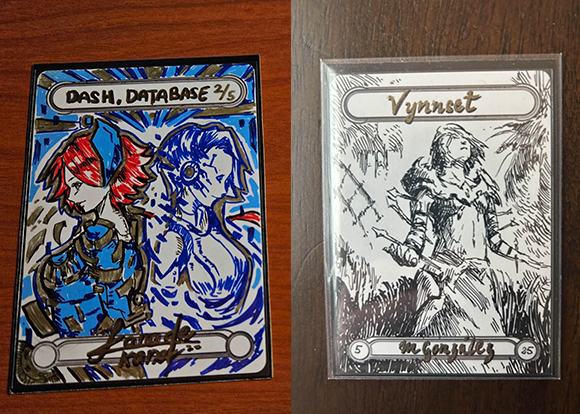
Item 1: The Arthouse Syndicate (AHS) Products
These cards were distributed to a small number of artists with the intention that the artists would sketch on them before returning them to Arthouse Syndicate (AHS) based on their interpretations of certain heroes. The cards also featured advertisement backs promoting other AHS products.
Because these cards do not use an authentic Flesh and Blood card back and were never distributed by LSS, they fail the established definition. While collectible, they are not true APs.
Additionally, AHS operated independently and had no official affiliation with LSS.
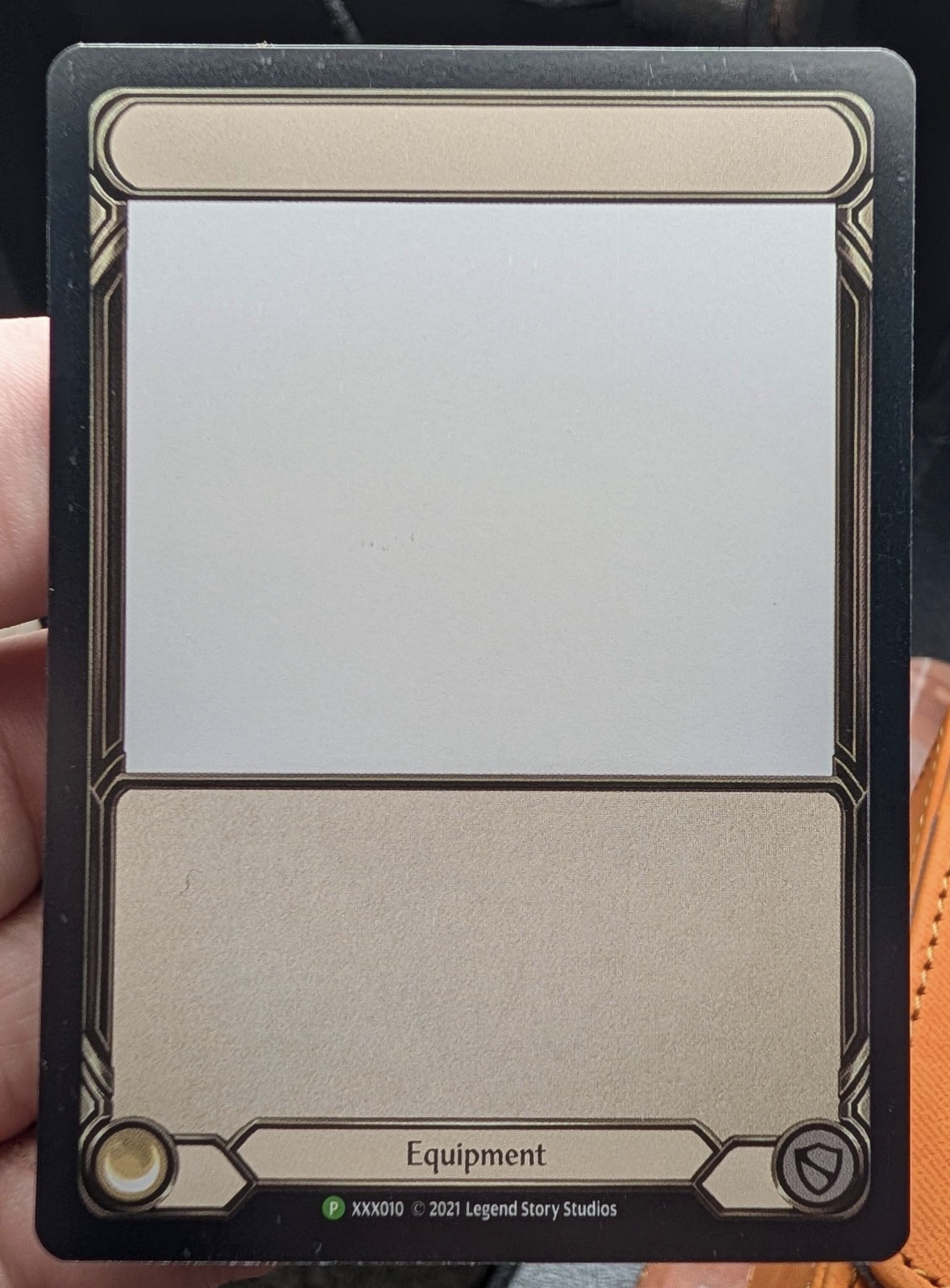
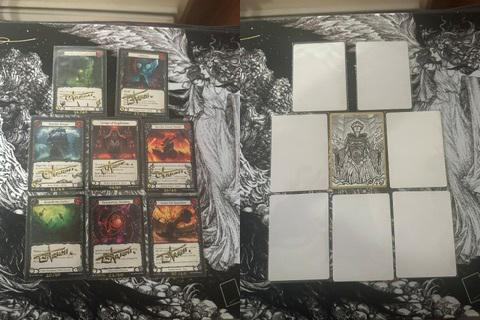
Item 2: Blank Tokens with “ARTIST” or “XXX010” Set Codes
These blank cards feature standard Flesh and Blood card backs while the fronts remain mostly empty aside from borders and set information. They have commonly been distributed to artists attending major events such as Callings, Pro Tours, and World Championships.
Artists frequently use these blanks to create custom commissions, especially multi-card hero and weapon displays.
However, these cards do not qualify as APs under the established criteria:
- the fronts are not official released game pieces,
- no side is completely white,
- and they were not distributed as artist proofs themselves.
Instead, these are better categorized as promotional artist materials provided for convention and event use.
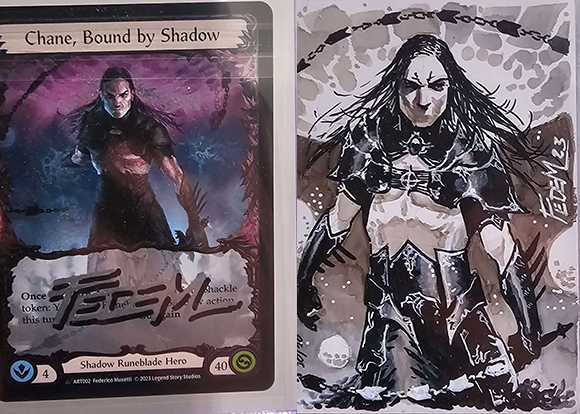
Item 3: The Dusk Till Dawn Prism (ART001) and Chane (ART002)
Dusk Till Dawn introduced two of the most controversial collectible items in Flesh and Blood history: the ART001 Prism and ART002 Chane cards.
Ten copies of each were inserted into booster packs as ultra-rare chase cards. These cards featured:
- white backs,
- Cold Foil treatment,
- alternate set codes,
- and artist sketches, signatures, and serialization.
Importantly, these cards were sent by LSS directly to the artists.
Under the definition established earlier, these cards meet every core requirement of an Artist Proof:
- authentic playable front face,
- white back,
- direct company-to-artist distribution.
LSS has nevertheless maintained that these are not APs because they feature Cold Foil treatment. However, decades of precedent across other TCGs show that foiling has been used on APs before.
The likely reason for LSS’s distinction is tournament legality and market positioning. Keeping these cards classified separately allows them to remain playable and potentially preserve their perceived value.
Regardless of official terminology, these cards fit the historical and functional definition of Artist Proofs far more closely than many items commonly referred to as APs within the community.

Item 4: The Slingshot Underground Ironrot Promos
Before Flesh and Blood officially launched, four common equipment cards from Welcome to Rathe were distributed to subscribers in 2018 alongside a playmat and holiday card.
These cards feature:
- plain white backs,
- unique set codes,
- and cardstock noticeably different from standard Flesh and Blood products.
The cardstock itself closely resembles material later used for official APs. However, two of the cards also contain incorrect wording and improper borders.
LSS has occasionally referred to these cards as Artist Proofs, but this classification does not align with the historical definition. These cards were never intended to be sent to artists and instead appear far more consistent with test prints or sample prints.
While extremely collectible and historically significant, they are not true Artist Proofs.
Conclusion
Artist Proofs occupy a unique space within Flesh and Blood collecting culture. Their rarity, artistic customization, and direct connection to the game’s illustrators make them some of the most personal and desirable collectibles in the game.
However, as the market has grown, the term “Artist Proof” has increasingly been stretched to describe items that do not fully fit the historical definition. Some of this confusion comes from collectors, some from marketing language, and some from LSS itself.
Without consistent terminology, collectors are left navigating unclear distinctions between APs, promotional blanks, test prints, and alternate collectibles. Establishing clearer standards benefits both collectors and artists by preserving transparency and trust within the market.
Not every rare white-backed Flesh and Blood item is an Artist Proof. But understanding why certain items are, or are not, considered APs is ultimately what gives the category meaning in the first place.